
India and China have held their first diplomatic talks since withdrawing troops from two face-off points in eastern Ladakh, reflecting on the lessons learned from the border row to prevent future incidents. The two sides agreed to maintain peace and tranquillity in border areas, prepare for the next meeting of Special Representatives on the boundary question, and highlighted the importance of regular exchanges and contacts at diplomatic and military levels. The talks come after the completion of the disengagement process from the last two friction points, following an agreement finalized in October 2022.

Asked about the recent meeting between Modi and Xi, and if Russia had any role in it, Alipov said, "We have not played any role in it, but we are happy that it took place in Kazan... We wholeheartedly welcome the meeting."

India's engagement with China is "complex" and Chinese attempts to unilaterally alter the status quo along the Line of Actual Control (LAC) in eastern Ladakh starting from April-May 2020 seriously disturbed the peace and tranquillity in border areas, the ministry of external affairs (MEA) said in a report on Monday.
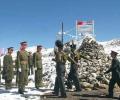
The Indian delegation led by Lt General Harinder Singh, the general officer commanding of Leh-based 14 Corps, and Commander of the Tibet Military District Maj Gen Liu Lin held an extensive meeting in Maldo on the Chinese side of the Line of Actual Control in eastern Ladakh on Saturday that began at around 11.30 am and went on till evening.
External affairs ministry spokesperson Arindam Bagchi said it is essential that "appropriate agreements between India and China of 1993 and 1996 are scrupulously followed".

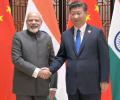
In his conversation with Prime Minister Narendra Modi, President Xi Jinping stressed that improving China-India relations serves common interests and is conducive to peace and stability of the region and the world.

In their first structured bilateral talks in nearly five years, Prime Minister Narendra Modi and Chinese President Xi Jinping Wednesday agreed that India and China can have a 'peaceful and stable' relationship by displaying maturity and mutual respect and endorsed the pact on the resolution of the dragging eastern Ladakh border row.

At an online media briefing, External Affairs Ministry Spokesperson Anurag Srivastava gave a run down of the events along the LAC in the eastern Ladakh region and held China responsible for the Galwan Valley clashes off June 15.
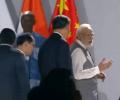
Prime Minister Narendra Modi conveyed to Chinese President Xi Jinping India's concerns on the "unresolved" issues along Line of Actual Control (LAC) in eastern Ladakh during a conversation on the sidelines of the BRICS summit, Foreign Secretary Vinay Mohan Kwatra said on Thursday.
"Discussions are on; what is going on is something confidential between us and the Chinese," he said when the moderator at the Bloomberg India Economic Forum pressed the minister to give a clear status of the border situation.

India's External Affairs Minister S Jaishankar has stated that peace and tranquility in border areas are essential for the development of bilateral ties with China. He said India will be discussing de-escalation and effective management of activities in border areas with China in the coming days, following the completion of troop disengagement in eastern Ladakh. Jaishankar emphasized the importance of respecting the Line of Actual Control (LAC), maintaining the status quo, and adhering to past agreements. The disengagement phase allows for discussions on other aspects of bilateral engagement, with national security interests prioritized. However, the statement sparked an uproar in the Rajya Sabha, with Opposition MPs demanding clarifications that were disallowed by the Chair, leading to a walkout.

Prime Minister Modi and President Xi held the conversation on Wednesday on the sidelines of the BRICS (Brazil, Russia, India, China, South Africa) summit in Johannesburg.

Following the disengagement, both sides will soon start the coordinated patrolling in their respective areas, sources added.
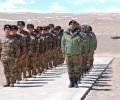
The Working Mechanism for Consultation and Coordination on India-China Border Affairs (WMCC) was established in 2012 as an institutional mechanism for consultation and coordination for the maintenance of peace and tranquillity in the border areas.
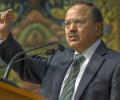
The officials said the focus of the talks was on 'full and enduring restoration of peace and tranquillity' along the border and also better coordination to ensure avoidance of such incidents in future.
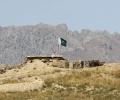
Pakistani troops violated the ceasefire along the Line of Control in Kashmir on the morning of the 65th Republic Day by resorting to unprovoked firing for three hours, army said.
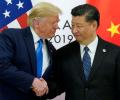
"We are capable of properly resolving the issues between us through dialogue and consultation. We do not need the intervention of the third party", he said.
The MEA said it was the Chinese side that recently undertakook activities hindering India's normal patrols in the areas.


India has not yet received any confirmation on Chinese President Xi Jinping's in-person participation at the upcoming G20 summit, people familiar with the matter said on Thursday amid reports that he is likely skip the conclave.

India said it is strongly committed to ensuring its sovereignty and territorial integrity.
The comments by External Affairs Ministry Spokesperson Anurag Srivastava came at a media briefing when asked about the fresh comments by the Chinese foreign ministry blaming India again for the border situation in eastern Ladakh.
China's state-run media said that the leadership of the two countries successfully solved the Doklam standoff in 2017 with 'concerted efforts and wisdom'.

Jaishankar said that both sides also exchanged views on the next steps in the India-China bilateral ties.
There was no visible forward movement in disengagement of troops in the remaining friction points as the Chinese side did not show flexibility in their approach on it at the 11th round of military talks.
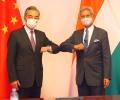
Jaishankar said full restoration and maintenance of peace and tranquillity in border areas was essential for the development of the bilateral ties.

India and China on Monday decided to deepen bilateral defence ties and maintain peace and tranquillity at the Line of Actual Control besides strengthening cooperation against terror, including at the international level.
The Chinese and the Indian troops were engaged in a standoff for 73 days in Doklam.

Both sides have completed creation of a buffer zone of three kilometres in the three friction points of Galwan Valley, Gogra and Hot Springs as part of a temporary measure aimed at reducing the possibility of any confrontation.

'Wang Yi said the border issue is important and we should stay committed to peacefully addressing it through consultation and coordination.'

Mahindra and Mahindra was the top gainer in the Sensex pack, advancing over 7 per cent, followed by Bajaj Finance, Reliance Industries, Maruti, TCS, HDFC Bank and Tata Steel. On the other hand, Bajaj Auto, HDFC, Bharti Airtel and HUL were among the laggards.

India has told China that disengagement at all friction points is necessary to contemplate de-escalation of troops in eastern Ladakh even as the foreign ministers of the two countries agreed to establish a hotline for "timely" communication and exchange of views.

'Both sides should, therefore, focus on easing tensions in the friction areas by refraining from any actions that may lead to an escalation in the situation'
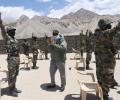
Only he, with his tremendous political capital and personal stature, can pull it off, observes B S Raghavan, the veteran civil servant.
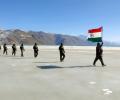
India has told China not to "shift goalposts" and "confuse" managing the border affairs and restoring peace at the frontiers with the larger issue of the resolution of the boundary question, which is dealt with by different designated mechanisms.
The Indian Army will continue to maintain its aggressive posturing in all disputed areas in eastern Ladakh and will not back off till status quo is maintained, sources said.
The sources said there was clear sign of withdrawal of structures and troops from the patrolling point 14 in Galwan Valley and that they are likely to move back more than a kilometre in the area.
'They also agreed that for the overall development of bilateral relations it was essential to maintain enduring peace and tranquillity in the border areas,' the MEA said in a statement.

The BDCA is yet another dose of insidious placebos administered on the people of India by their own government that has been in perpetual denial over the steady incremental loss of strategic Indian territory, says R N Ravi

In the first highest level face-to-face contact between the two sides after border tension erupted in eastern Ladakh in early May, Singh and Wei met for two hours and 20 minutes in Moscow on Friday evening on the sidelines of a meeting of the defence ministers of the Shanghai Cooperation Organisation.
 © 2026 Rediff.com - Advertise with us - Disclaimer - Privacy Policy - Sitemap - Feedback - About us - Terms of use - Grievances